https://www.youtube.com/watch?v=_AE5JC_4IOo
TURBO/ TURBINE
Great, so what turbo do I choose?
Let’s take each case and calculate a turbo choice based on the intended power increase. The first step is to read the
Turbo Tech Expert section.
This article explains the reading of a compressor map and the equations
needed to properly match a turbo. The examples given, however, are for
gasoline engines, so we are going to work some additional examples here
using those same equations but with a diesel engine. Matches will be
calculated with an
Air Fuel Ratio (AFR) of 22-to-1 for low or no smoke performance. Likewise a typical
Brake Specific Fuel Consumption (BSFC) is in the range of 0.38.
https://www.youtube.com/watch?v=DwiNkiBjfck&t=7s
https://www.youtube.com/watch?v=IYaqskg3Wh0
A realistic goal
See the Example tag to get started!
The
first example will be for the Daily Driver/Work Truck/Tow Vehicle
category. This includes vehicles up to 150HP over stock. But wait, this
power level can be accomplished with just a chip or tuning module. So
why bother with a new upgrade turbo? An upgrade turbo will enhance the
gains made by installing the chip and other upgrades. The extra air and
lower backpressure provided by the upgrade turbo will lower EGTs, allow
more power with less smoke and address durability issues with the stock
turbo at higher boost pressures and power levels. Because this will be a
mild upgrade, boost response and drivability will be improved across
the board.
Example
I
have a 6.6 liter diesel engine that makes a claimed 325 flywheel
horsepower (about 275 wheel horsepower as measured on a chassis dyno). I
would like to make 425 wheel hp; an increase of 150 wheel horsepower.
Plugging these numbers into the formula and using the AFR and BSFC data
from above:
Recall from Turbo Tech 103:

Where,
- Wa = Airflowactual (lb/min)
- HP = Horsepower Target (flywheel)
- A/F = Air/Fuel Ratio
- BSFC/60 = Brake Specific Fuel Consumption (lb/(Hp*hr))/60 (to convert from hours to minutes)
So
we will need to choose a compressor map that has a capability of at
least 59.2 pounds per minute of airflow capacity. Next, how much boost
pressure will be needed?
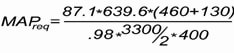
Calculate the manifold pressure required to meet the horsepower target.
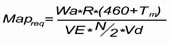
Where,
- MAPreq = Manifold Absolute Pressure (psia) required to meet the horsepower target
- Wa = Airflowactual (lb/min)
- R = Gas Constant = 639.6
- Tm = Intake Manifold Temperature (degrees F)
- VE = Volumetric Efficiency
- N = Engine speed (RPM)
- Vd = engine displacement (Cubic Inches, convert from liters to CI by multiplying by 61, ex. 2.0 liters * 61 = 122 CI)
https://www.youtube.com/watch?v=Oy0eQh8TYgk
For our project engine:
- Wa = 59.2 lb/min as previously calculated
- Tm = 130 degrees F
- VE = 98%
- N = 3300 RPM
- Vd = 6.6 liters * 61 = 400 CI
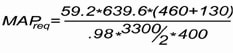
=
34.5 psia (remember, this is absolute pressure; subtract atmospheric
pressure to get gauge pressure, 34.5 psia – 14.7 psia (at sea level) =
19.8 psig)
So now we have a
Mass Flow and
Manifold Pressure.
We are almost ready to plot the data on the compressor map. Next step
is to determine how much pressure loss exists between the compressor and
the manifold. The best way to do this is to measure the pressure drop
with a data acquisition system, but many times that is not practical.
Depending upon flow rate and charge air cooler size, piping size and
number/quality of the bends, throttle body restriction, etc., you can
estimate from 1 psi (or less) up to 4 psi (or higher). For our examples
we will estimate that there is a 2 psi loss. Therefore we will need to
add 2 psi to the manifold pressure in order to determine the
Compressor Discharge Pressure (P2c).

Where,
- P2c = Compressor Discharge Pressure (psia)
- MAP = Manifold Absolute Pressure (psia)
 = Pressure loss between the Compressor and the Manifold (psi)

To
get the correct inlet condition, it is now necessary to estimate the
air filter or other restrictions. In the Pressure Ratio discussion
earlier we said that a typical value might be 1 psi, so that is what
will be used in this calculation. Also, we are going to assume that we
are at sea level, so we are going to use an ambient pressure of 14.7
psia. We will need to subtract the 1 psi pressure loss from the ambient
pressure to determine the
Compressor Inlet Pressure (P1).
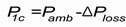
Where:
 = Compressor Inlet Pressure (psia)
 = Ambient Air pressure (psia)
- = Pressure loss due to Air Filter/Piping (psi)

With this, we can calculate Pressure Ratio (

) using the equation.

For the 2.0L engine:

= 2.7
We
now have enough information to plot these operating points on the
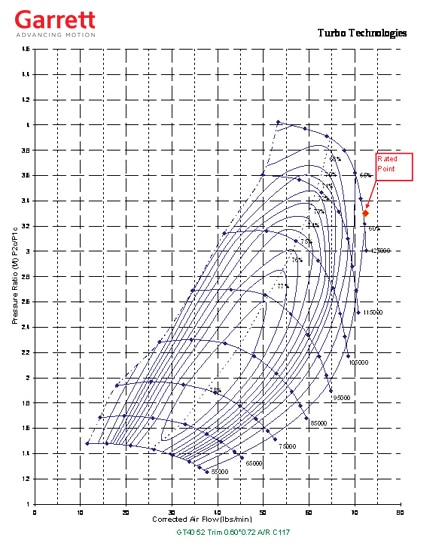
compressor map. First we will try a GT3788R. This turbo has an 88mm tip
diameter 52 trim compressor wheel with a 64.45 mm inducer.
As you
can see, this point falls nicely on the map with some additional room
for increased boost and mass flow if the horsepower target climbs. For
this reason, the GT37R turbo family is applied on many of the Garrett
Powermax turbo kits that are sized for this horsepower range.
For
the next example, let’s look at the Weekend Warrior. This category is
for daily driven vehicles that have up to 250 horsepower over stock or
525 wheel horsepower.
Plugging that power target into our formula yields an airflow requirement of:

And a pressure ratio of:
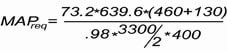

= 45.5 psia
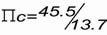
= 3.3
https://www.youtube.com/watch?v=10HOfyks_dA
https://www.youtube.com/watch?v=_AE5JC_4IOo
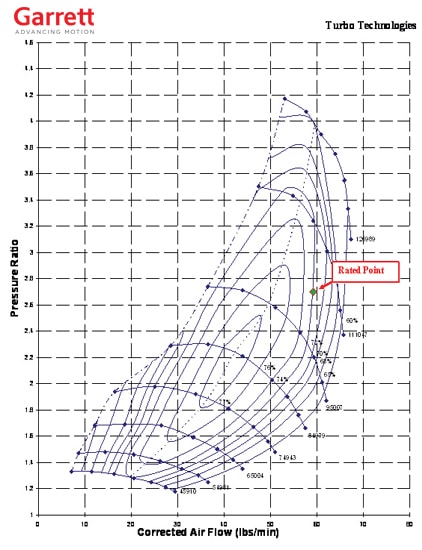
Garrett GTW3884R
Greddy Trust T88-38GK
HKS GTIII5R
Precision Turbo Gen 2 6466
Looking
at the previous map, the compressor does not flow enough to support
this requirement, so we must look at the next larger size compressor.
(Technically,
the engine could probably easily make this power with the previous
compressor, but it would be at risk of more smoke, higher EGT’s and
backpressure; kind of like pushing a stock compressor too far…)
The next larger turbo is a GT4094R and is shown below.
Another
option that could also be considered is the GT4294R which has a
slightly larger inducer compressor and the next larger frame size
turbine wheel.
The larger wheel inertia’s will slow down the response a bit, but provide better performance at the top end of the rpm range.
For
the next example, let’s look at the Extreme Performance. This category
is for real hot rod vehicles that have up to 350 horsepower over stock
and owners that are willing to give up some of the daily utility in
order to achieve higher power gains.
Plugging that power target into our formula yields an airflow requirement of:

And a pressure ratio of :
= 50.8 psia

= 52.8 psia
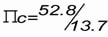
=3.8
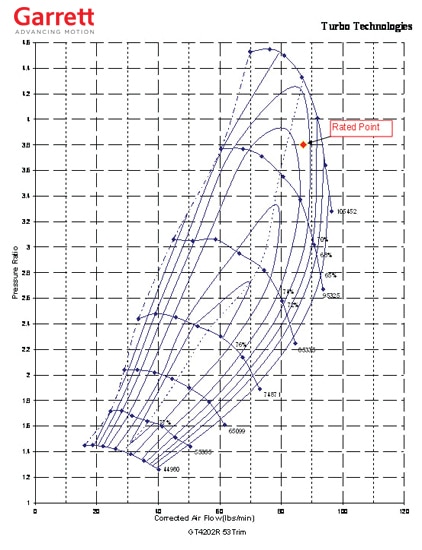
For
this flow and pressure ratio, the GT4202R is appropriate and is shown
below. Since this is approaching a pressure ratio of 4-to-1, we are
about at the limit of a single turbo on an engine of this size.
Final Case: Competition Category
The
final case is the Competition category. Since this is a special case
and there are so many ways to go about an ultimate power diesel
application, it is not possible to cover it adequately in this article.
There are, however, some general guidelines. At this power level, as
stated above, it is a good idea to consider a series turbo application.
This is a situation where one turbo feeds another turbo, sharing the
work of compressing the air across both compressors. A larger turbo is
designated as the “low-pressure” turbo and the smaller secondary stage
as the “high pressure” turbo. The low-pressure compressor feeds the
high-pressure compressor which then feeds the intake. On the
turbine-side the exhaust first passes through the high-pressure turbine
and then on to the low-pressure turbine before being routed out through
the tailpipe. We can still calculate the required mass flow, but the
pressure ratio is more involved and questions should be discussed with
your local Garrett Powermax distributor. To calculate the required mass
flow, we use the normal equation. This time the power target will be 500
wheel horsepower over stock, for a total of 775 wheel horsepower

This
air flow rate will apply only to the low-pressure compressor as the
high-pressure compressor will be smaller because it is further
pressurizing already compressed air. In most cases, the high-pressure
turbo tends to be about two frame sizes smaller than the low pressure
stage. So in this case, after selecting the appropriate low-pressure
turbo (hint: look at the GT4718R compressor map), a GT4088R or GT4094R
would be the likely candidates.
One more comment on choosing a
properly sized turbine housing A/R. A smaller A/R will help the turbo
come up on boost sooner and provide a better responding turbo
application, but at the expense of higher back pressure in the higher
rpm zones and, in some cases, a risk of pushing the compressor into
surge if the boost rises too rapidly. On the other hand, a larger A/R
will respond slower, but with better top end performance and reduced
risk of running the compressor into surge. Generally speaking, the
proper turbine housing is the largest one that will give acceptable
boost response on the low end while allowing for more optimal top end
performance.
This information should be used as a starting point
for making decisions on proper turbo sizing. Of course, for more
specific information on your engine, consult a Garrett Powermax
distributor.
Sources:
https://www.garrettmotion.com/racing-and-performance/choose-a-turbo/
Thank you Garrett Motion, Precision Turbo, Xona, Forced Performance, Borg Warner, Full-Race, HKS, & Greddy.
👹👹#Go #Big #or #Go #Home 👹👹
#awd #4stroke #Nihhon #Quartermile #muscle #908
InsyaAllah
All the American, English, German, Russian, Greek, Thailand, Malaysia, Japanese, Australian, New Zealand, Arab Saudi, China, Badass Dragster and Tuner may God Bless us All. Long live Quartermile World.